ChistaDATA · Real-Time Analytics Engineering · 100% Open-Source ClickHouse
High-Performance Real-Time Analytics with ClickHouse, Engineered for Sub-Second Insight at Petabyte Scale
Real-time analytics with ClickHouse is how more than 200 organizations turn high-velocity event streams into decisions while they still matter. ChistaDATA designs, tunes, and operates the full ClickHouse analytics tier — columnar schema design, streaming ingestion through Kafka, sharding and ReplicatedMergeTree replication, high availability, disaster recovery, and 24×7×365 enterprise support — so p95 query latency stays sub-second as data volume and concurrency grow by orders of magnitude.
The ClickHouse Advantage
Why real-time analytics with ClickHouse outruns every row-store it replaces
ClickHouse is an open-source, column-oriented database built for analytical workloads that traditional row-oriented systems cannot sustain. Instead of reading entire rows to answer a question about three columns, ClickHouse reads exactly the columns a query touches — and four engineering decisions in its core turn that storage model into millisecond-class real-time analytics over billions of rows.
Vectorized Query Execution
ClickHouse processes data in large column blocks using SIMD instructions, applying the same operation to thousands of values per CPU cycle. Aggregations that scan billions of records return in sub-second time because the execution engine is built around CPU cache efficiency, not row-at-a-time iteration. The result: analytical latency drops from minutes to milliseconds on identical hardware.
Columnar Compression, 10–100×
Storing each column contiguously lets codecs such as LZ4 and ZSTD — plus specialized codecs like Delta and DoubleDelta for time series — compress data 10–100× versus row storage. Less data on disk means less I/O per query, lower infrastructure cost, and more of the working set held in page cache.
Massively Parallel Processing
Every query fans out across all CPU cores on a node and, through distributed tables, across every shard in the cluster. Query throughput scales linearly with hardware, so the same architecture that serves gigabytes on a single node serves petabytes on a multi-region cluster — without an application rewrite.
Streaming Ingestion Without Query Impact
MergeTree tables absorb continuous high-throughput inserts — millions of rows per second — while serving concurrent analytical queries. Background merges keep parts optimal, and Kafka engine tables with materialized views turn event streams into queryable data within seconds of arrival. This is the property that makes ClickHouse a real-time analytics database rather than a batch warehouse.
Reference Architecture
The real-time analytics architecture ChistaDATA engineers on ClickHouse
Event streams enter through Kafka, land in ClickHouse via Kafka engine tables and materialized views, replicate across shards under ClickHouse Keeper coordination, tier cold data to object storage, and serve dashboards and APIs at sub-second p95 — one pipeline, engineered end to end.
Illustrative real-time analytics reference architecture (verified against ClickHouse 26.8 LTS and applicable to 24.x and later; ClickHouse Keeper shown in place of ZooKeeper). Shard and replica counts, topic layout, and storage tiers are sized per workload during architecture engagements — see the ClickHouse architecture documentation for engine internals.
What makes this real-time analytics architecture production-grade is not any single component — it is the measurement discipline wrapped around it. Every ChistaDATA engagement instruments the pipeline end to end: ingestion lag from Kafka offset to queryable row, part counts and merge backlog from system.parts and system.merges, mutation progress from system.mutations, and query latency distributions from system.query_log. The p95 and p99 numbers on executive dashboards are computed from the same telemetry engineers use to tune the cluster, so performance conversations happen against one source of truth.
Capacity decisions follow the measurements. When ingestion velocity, concurrent query load, or retention windows change, the sharding plan, replica count, and storage tiers are re-validated with workload replay rather than resized on intuition. The result is a real-time analytics platform whose behavior under peak seasonal load, a regional failover, or a ten-times data-growth year has been demonstrated before those events happen — not discovered during them.
ClickHouse Engineering Services
Three engineering disciplines that keep real-time analytics fast under load
ChistaDATA goes beyond providing access to ClickHouse technology: every engagement is led by senior ClickHouse engineers, documented in decision-grade written deliverables, and validated against production telemetry — system.query_log, system.parts, system.merges — rather than synthetic benchmarks.
Performance Engineering & Query Optimization
Architecture and schema decisions determine ClickHouse performance long before the first query runs. ChistaDATA designs deployments around your workload — from single-node clusters to globally distributed, multi-datacenter estates — then engineers the data model to match: primary keys selected for sort-order locality, partitioning aligned to retention and query windows, data types minimized for storage overhead, and skip indexes, projections, and materialized views applied where the query log proves they pay for themselves.
Slow queries are profiled against system.query_log and EXPLAIN PIPELINE output, then tuned at every layer — SQL, schema, MergeTree settings, max_threads, max_memory_usage, and compression codec selection (LZ4 for speed-critical paths, ZSTD for storage-heavy ones). Start with a ClickHouse performance audit or the pre-engagement questionnaire.
- Cluster topology design and capacity planning
- MergeTree schema, sort-key, and partitioning strategy
- Skip-index, projection, and materialized-view engineering
- Query profiling with system tables — measured, not guessed
- Compression codec selection balancing latency and cost
Scalability: Sharding, Replication & Capacity Planning
Real-time analytics platforms rarely fail at launch — they fail at 10× growth. ChistaDATA engineers horizontal scale-out with sharding strategies that keep data placement balanced, distributed tables for seamless cross-node querying, and ReplicatedMergeTree for automatic data synchronization and read capacity. Capacity plans are built bottom-up from measured ingestion velocity and query concurrency, then validated with workload replay before production cutover.
Cloud-native estates add Kubernetes orchestration, auto-scaling compute, and object-storage tiering (AWS S3, Google Cloud Storage, Azure Blob Storage) so storage scales independently of compute — and cost scales with usage, not peak provisioning.
- Sharding and distribution-key design for balanced placement
- ReplicatedMergeTree replication and read-routing
- Bottom-up capacity planning from production telemetry
- Kubernetes orchestration and auto-scaling on AWS, GCP, Azure
- Load balancing across replicas to eliminate hot spots
High Availability & Disaster Recovery
Downtime in the real-time analytics tier is downtime in decision-making. ChistaDATA implements a minimum of three replicas per shard, a hardened three-node ClickHouse Keeper (or ZooKeeper) quorum to protect cluster coordination and prevent replicated tables from degrading to read-only, and multi-datacenter or multi-availability-zone replica placement for regional failure tolerance — engineered against defined RPO and RTO targets, not aspirations.
Automated backups with clickhouse-backup land in object storage with verification and point-in-time recovery, and quarterly restore and failover drills prove the DR posture works before an incident does. Around it all: 24×7 monitoring and managed operations with a fifteen-minute Severity 1 response SLA.
- Three-replica shards on ReplicatedMergeTree
- ClickHouse Keeper / ZooKeeper quorum design and hardening
- Multi-region replication and cross-DC failover
- Automated, verified backups with point-in-time recovery
- Quarterly restore and failover drills against RPO/RTO targets
Deployment Options
On-premise or cloud-native — the same open-source ClickHouse, zero lock-in
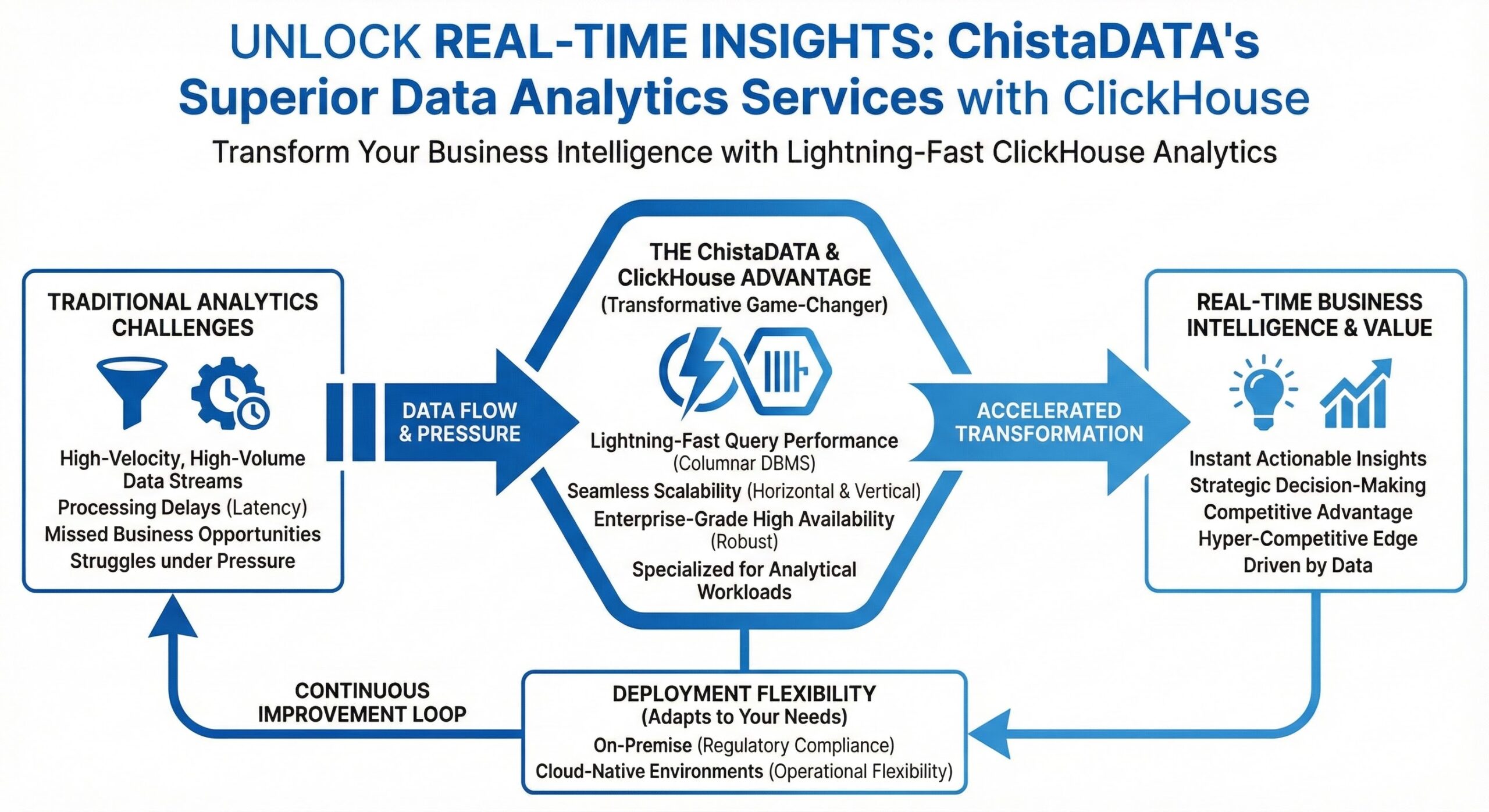
A real-time analytics platform is an infrastructure commitment, and the deployment model has to follow the business — regulatory posture, data residency, existing operations, and cost structure — not the other way around. ChistaDATA operates high-performance real-time analytics estates in both models with identical engineering discipline: the same schema standards, the same telemetry-driven tuning, the same HA/DR drills, and the same 24×7×365 support bench. Because everything runs on 100% open-source ClickHouse, moving between models later is a migration project, never a hostage negotiation.
On-Premise Deployments
For organizations with existing data centers or strict regulatory and data-residency mandates, ChistaDATA delivers hardware sizing and selection, network architecture, security hardening, and data-center operating practices for high-performance real-time analytics clusters inside your own infrastructure — with the same observability and SLA discipline as any cloud estate.
Cloud-Native Deployments
On AWS, Google Cloud, and Microsoft Azure, ChistaDATA architects real-time analytics platforms with compute-storage separation, Kubernetes-orchestrated cluster lifecycle management, and integration with cloud monitoring, logging, and backup services. Cost engineering is built in: usage-based resource allocation, automated data tiering between storage classes, and ClickHouse’s own compression doing the heaviest lifting on the storage bill.
Industry Use Cases
Where sub-second real-time analytics changes the business outcome
The same architecture — streaming ingestion, columnar storage, distributed execution — shows up wherever the value of a data point decays in seconds.
FinTech
Score millions of transactions per second against fraud patterns, run real-time risk and portfolio analysis on high-frequency market data, and profile creditworthiness with millisecond query response.
E-Commerce & Retail
Real-time stock visibility across locations, recommendation engines fed by live behavioral events, and campaign and funnel analytics with sub-second latency for same-session decisions.
Telecommunications
Real-time analytics on network logs and telemetry at line rate — fault detection, service-quality monitoring across call detail records, and proactive capacity planning.
Media & Entertainment
Real-time analytics on audience engagement for programming decisions, immediate ad-campaign optimization, and personalized content recommendations for streaming platforms.
Gaming
Real-time analytics on player actions, progression, and monetization; behavioral anti-cheat detection on live game logs; and continuous server-health monitoring at fleet scale.
AdTech
Bid-request analytics in millisecond-sensitive auction windows, multi-touch attribution across complex user journeys, and granular audience segments refreshed continuously.
SaaS & Observability
Feature-adoption and user-journey analytics, petabyte-class log and metrics ingestion for operational monitoring, and accurate real-time usage reporting for billing. See also database warehousing support.
Why ChistaDATA
The ClickHouse partner behind 200+ production analytics platforms
Most teams discover ClickHouse, fall in love with the raw performance, and then hit a wall the moment real-time analytics workloads cross from prototype into petabyte-scale production: sort keys are wrong, partitioning was copy-pasted from a blog post, ReplicatedMergeTree is misconfigured against its Keeper quorum, and distributed queries fan out to shards that scan terabytes when a single partition would have answered in milliseconds. ChistaDATA exists to engineer the durable, audit-grade ClickHouse infrastructure that keeps working when data volume grows ten times and query concurrency grows fifty.
Deep Technical Bench
Senior ClickHouse engineers with hands-on depth in MergeTree internals, optimization technique, and production operations — earned across implementations in every major industry vertical, from startups to Fortune 500 estates.
Tailored, Not Templated
Architectures, configurations, and service packages engineered for your data characteristics, latency targets, scalability needs, and budget — never a one-size-fits-all deployment. Learn how ClickHouse fits your estate in Understanding ClickHouse and the MergeTree deep dive.
End-to-End Lifecycle
Assessment, architecture, implementation, optimization, and 24×7×365 operations under one engagement — including migrations to ClickHouse from Redshift, Snowflake, BigQuery, Druid, Pinot, Vertica, and Elasticsearch.
Measured Outcomes
Recommendations anchored in system-table telemetry and p95/p99 latency outcomes. Query performance improvements of 10–100× are common results of schema and query engineering — documented per engagement, never quoted as a generic promise.
Cost-Engineered
Compression, tiering, and right-sized topology designed to cut total cost of ownership — often dramatically — while raising analytical capability. No license fees, no vendor lock-in, no surprise invoices.
AI-Ready Analytics
The same real-time analytics foundation extends to vector search and retrieval workloads — see Generative AI support with ClickHouse and the data strategy playbook.
The practice model is deliberately engineering-heavy. Every customer receives a named principal engineer and a Technical Account Manager; every recommendation ships as a written, decision-grade document with the measurements that justify it; and every quarter the cluster architecture, capacity plan, and DR posture are reviewed against what production telemetry actually shows. That cadence is how a real-time analytics platform stays fast in year three, not just in the launch quarter — and it is why 200+ organizations keep their ClickHouse estates with ChistaDATA year after year.
Frequently Asked Questions
Real-time analytics with ClickHouse — engineering FAQ
Why is ClickHouse faster than traditional databases for real-time analytics?
ClickHouse stores data column by column, executes queries on vectorized blocks using SIMD instructions, and parallelizes work across every CPU core and shard. Combined with columnar compression that cuts I/O 10–100×, analytical queries that take minutes on row-oriented databases return in milliseconds.
Can ClickHouse ingest streaming data while serving queries?
Yes. MergeTree tables absorb continuous high-throughput inserts — millions of rows per second — without degrading concurrent query performance. Kafka engine tables and materialized views move event streams into queryable tables within seconds of arrival, which is what powers live dashboards and production real-time analytics.
How does ChistaDATA make ClickHouse highly available?
A minimum of three replicas per shard on ReplicatedMergeTree, a hardened three-node ClickHouse Keeper (or ZooKeeper) quorum, multi-region replica placement, automated verified backups with clickhouse-backup, and 24×7 monitoring — validated through quarterly restore and failover drills against defined RPO/RTO targets.
Does ChistaDATA support both on-premise and cloud-native deployments?
Yes — on-premise clusters for regulated environments, and cloud-native estates on AWS, GCP, and Azure with Kubernetes orchestration, compute-storage separation, and object-storage tiering. Everything runs on 100% open-source ClickHouse with zero vendor lock-in.
Which industries run real-time analytics on ClickHouse with ChistaDATA?
FinTech, e-commerce, telecommunications, media, gaming, AdTech, and SaaS — anywhere the value of a data point decays in seconds. The use-case section above maps the concrete workloads per industry.
How fast can ChistaDATA respond to a ClickHouse incident?
The published enterprise SLA is a fifteen-minute response for Severity 1 incidents, 24×7×365, from an on-call bench of senior ClickHouse engineers with full context on your cluster — see ClickHouse enterprise support.
How long does a migration to ClickHouse for real-time analytics take?
A typical migration from Redshift, Snowflake, BigQuery, Druid, or Elasticsearch runs six to sixteen weeks depending on schema complexity, pipeline count, and cutover constraints. ChistaDATA scopes every migration against a documented business case with agreed latency and cost-per-query targets, executes schema conversion and CDC-based dual-write in parallel with the legacy platform, and cuts over only after workload replay validates performance — see the ClickHouse migration practice for the runbook approach.
What monitoring does ChistaDATA provide for ClickHouse clusters?
24×7×365 monitoring of query latency percentiles, ingestion throughput and lag, replication health, merge and mutation backlog, Keeper quorum state, and disk and memory headroom — with alert thresholds tuned per workload and every alert backed by a runbook. The same telemetry feeds quarterly architecture reviews, so tuning decisions stay grounded in production data rather than assumptions.
Let’s engineer the real-time analytics tier the business deserves
Whether the next milestone is a migration off Redshift, Snowflake, or BigQuery, a real-time analytics performance program against a strict latency SLA, or a fully managed ClickHouse contract — a fifteen-minute conversation with a ChistaDATA principal engineer is enough to know whether ChistaDATA is the right partner. Reach the engineering team through the contact form.
ChistaDATA Inc. · San Francisco Bay Area · 11 global offices · 24×7×365 ClickHouse engineering operations
Further Reading on Real-Time Analytics