ChistaDATA · Full-Stack ClickHouse Infrastructure Operations . 24/7 Enterprise-grade support
Enterprise ClickHouse Consulting, Support, Platform Engineering, Data Analytics, and Managed Services, Engineered for Real-Time Analytics at Petabyte Scale
More than 200 organisations worldwide entrust their ClickHouse estates to ChistaDATA. Consulting, consultative support and managed services are delivered by one senior engineering bench, so the architect who designs the sort key is the engineer who answers the pager.
Every engagement is led by principal ClickHouse engineers, documented in decision-grade written deliverables, and proven against production telemetry rather than benchmarks.
- ·Architecture and capacity planning
- ·Performance engineering and query optimisation
- ·MergeTree schema, skip-index, materialized-view and projection design
- ·Sharding and horizontal scalability
- ·ReplicatedMergeTree and ClickHouse Keeper replication
- ·High availability, disaster recovery, business continuity
- ·Data reliability engineering and observability
- ·Security, governance and compliance
- ·Ingestion: Kafka, Debezium CDC, Kinesis, RabbitMQ, Flink
- ·Deployment: self-managed, Kubernetes, hybrid and multi-cloud
- ·ClickHouse Cloud and DBaaS cost and performance optimisation
- ·Migration engineering off legacy analytics platforms
- ·The analytical layer behind Generative AI and ML workloads
- ·Principal-engineer ownership on every engagement
- ·Decision-grade written deliverables, versioned and reviewed
- ·Proven against production telemetry: system.query_log, parts, merges, Keeper
- ·S1 response in 15 minutes, 24×7×365
- ·100% open-source GPL ClickHouse, no proprietary layer
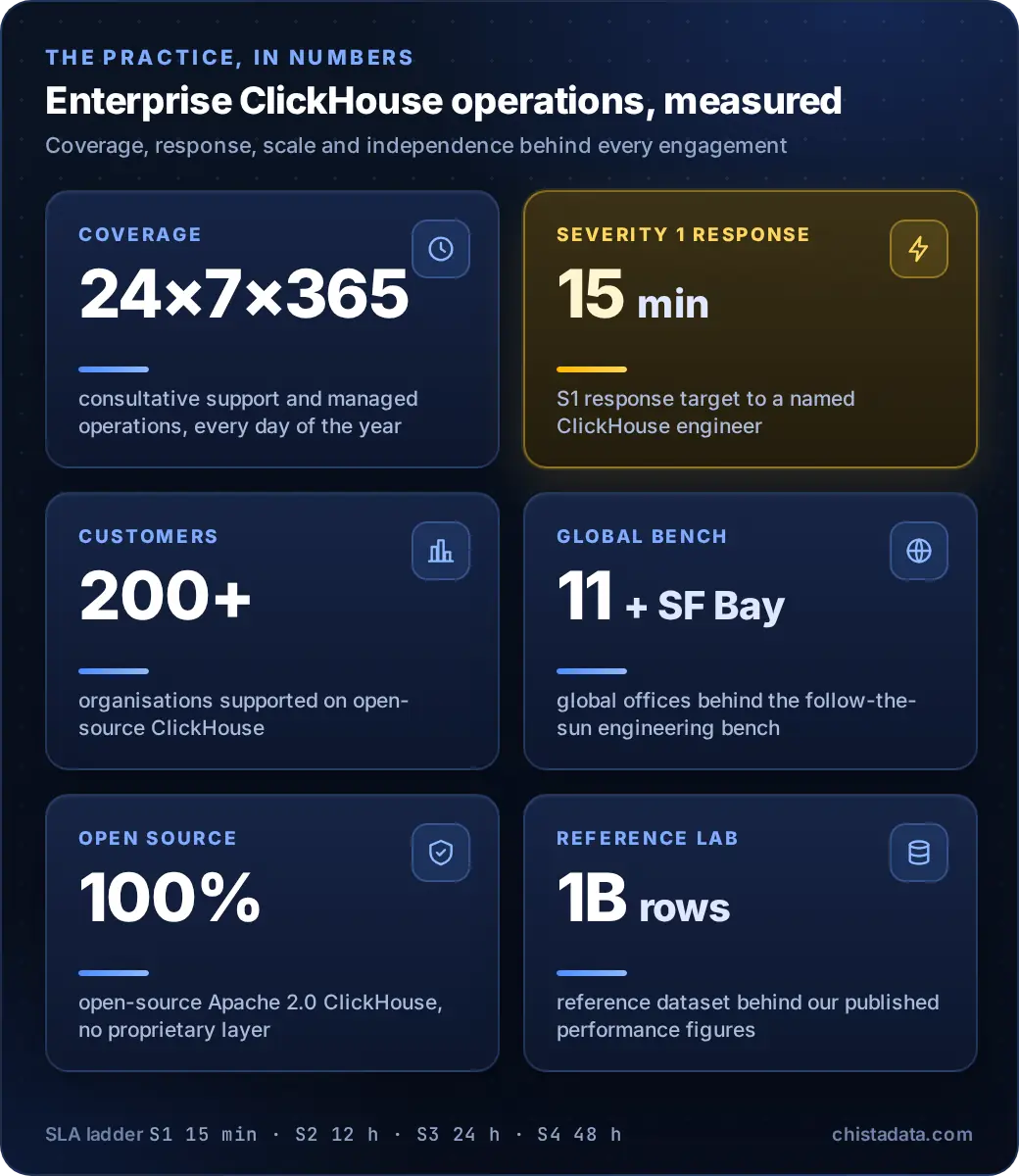
11
Global offices delivering ClickHouse engineering
24×7×365
Enterprise consultative support coverage
100%
Open-source ClickHouse — zero vendor lock-in
15 min
Severity 1 incident response SLA
200+
Customers worldwide served by the ClickHouse practice
The ChistaDATA ClickHouse Practice
The ClickHouse engineering partner behind the world’s most demanding real-time analytics platforms
ChistaDATA Inc. is a full-stack ClickHouse infrastructure operations provider: enterprise consultative support and managed services for organisations that need sub-second analytics at petabyte scale. Our engineering bench has taken ClickHouse clusters into production at AdTech operators processing trillions of events a day, observability platforms ingesting tens of millions of metrics per second, fintech analytics engines running fraud-detection windows in real time, and SaaS platforms where the analytical tier is the product.
Every engagement is led by senior ClickHouse engineers, not generalist consultants who picked up ClickHouse last quarter. The operating model rests on principal-engineer ownership, written architecture deliverables, measurable performance outcomes and the discipline of running real clusters under real production load. Customers gain a globally distributed bench of ClickHouse specialists across performance engineering, scalability, high availability, data reliability engineering, security and the runbooks that keep ClickHouse fast while data volume grows ten to one hundred times in twelve months.
Every offering is grounded in the same engineering rigour, the same audit-grade documentation and the same commitment to 100% open-source GPL ClickHouse. Our published measurements, from a billion-row lab on ClickHouse 26.7 to a row-store comparison, are reproducible to the row.
Most analytics teams discover ClickHouse, fall for the raw performance, and hit a hard wall the moment workloads cross from prototype into petabyte production. The failure modes repeat from one estate to the next, and every one of them is a design decision that was never made on purpose.
ChistaDATA exists to engineer the boring, durable, audit-grade ClickHouse infrastructure that keeps working when data volume grows ten times, query concurrency grows fifty times, and the on-call pager finally goes quiet.
The cluster works, until it stops working. Our job is the second half of that sentence.
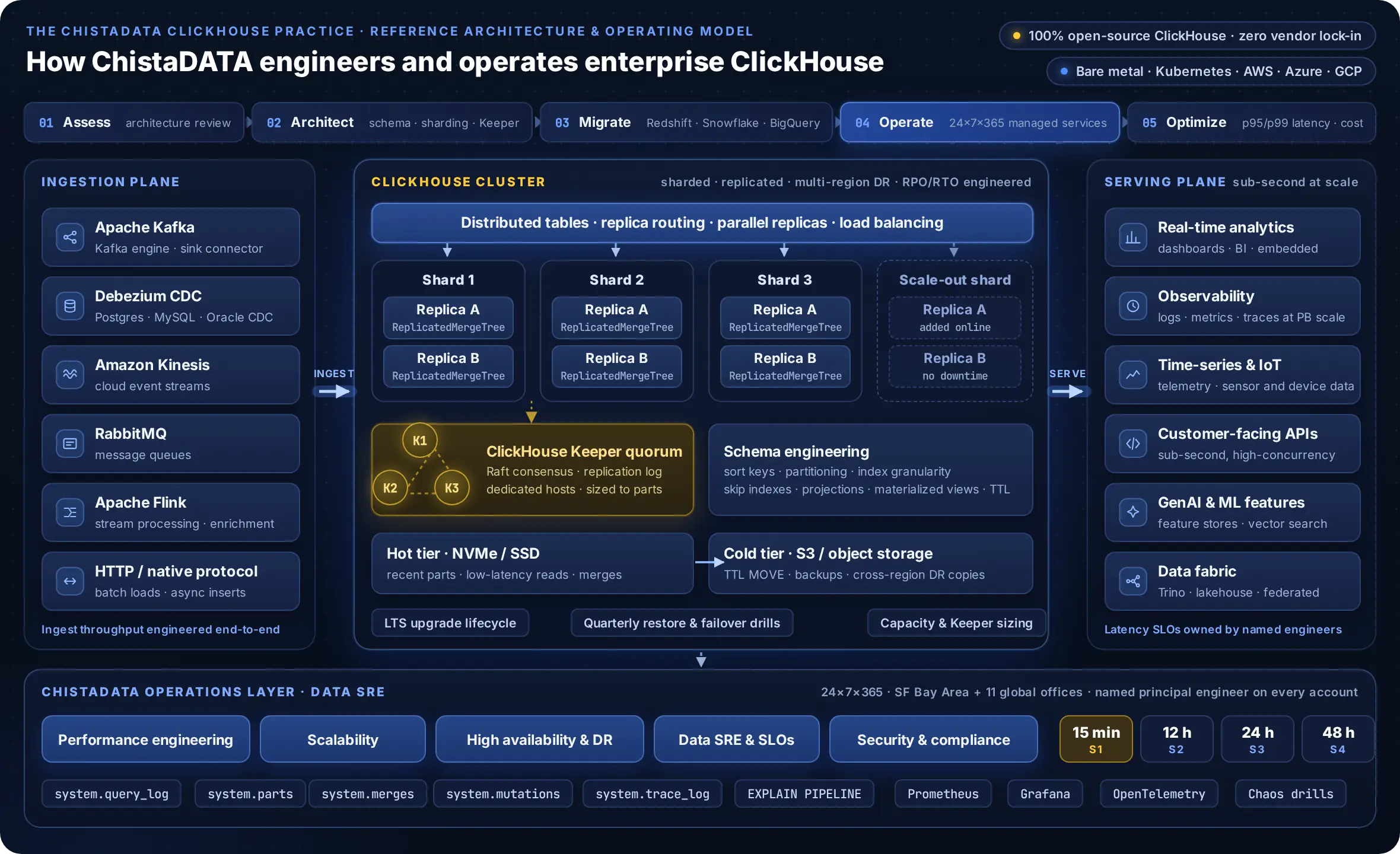
The ChistaDATA delivery model is engineered for organizations that treat data as a strategic asset and analytics as a competitive weapon. Every customer receives a Technical Account Manager, a named principal ClickHouse engineer, and a 24×7×365 incident response bench backed by the published enterprise SLA — fifteen minutes for Severity 1, twelve hours for Severity 2, twenty-four hours for Severity 3, forty-eight hours for Severity 4. The commercial model is equally engineered for predictability: on-site consulting at US$600 per hour, remote at US$450 per hour, an unlimited Enterprise Support plan at US$75,000 per year, and tiered managed services from 4 to 40 engineering hours per month. No license games. No vendor lock-in. No surprise invoices.
SIX Pillars of ClickHouse Engineering Excellence
The disciplines every ChistaDATA ClickHouse engagement is engineered against
Audits, runbooks, migrations, and on-call rotations all map back to the same five disciplines — measured, instrumented, and continuously validated against the ClickHouse cluster running in production.
01
ClickHouse Performance Engineering
Query plans, MergeTree skip-index design, primary-key granule selection, projection engineering, materialized-view denormalization, vectorized execution analysis, and CPU SIMD profiling — not dashboard guesses. ChistaDATA engineers instrument workloads with system.query_log, system.parts, system.merges, system.mutations, and system.trace_log, then tune at every layer: SQL, schema, indexes, MergeTree variables, cache settings, OS, filesystem, and storage. Outcomes are measured in p95 and p99 query latency, sustained ingestion throughput, and headroom under peak load. Request a ClickHouse performance audit or review the pre-engagement questionnaire to begin.
02
ClickHouse Scalability
Sharding strategy, distributed table design, replica topology, ReplicatedMergeTree configuration, ZooKeeper and ClickHouse Keeper sizing, read-routing through cluster() and remote(), parallel-replica execution, and S3/Object storage tiering architected for the workload the business actually runs. Capacity plans are built bottom-up from real ingestion velocity and query concurrency — not vendor sizing tables — and validated against workload replay before production cutover. ChistaDATA has scaled ClickHouse fleets from a single node to multi-region clusters running thousands of nodes serving sub-second analytics at petabyte scale.
03
ClickHouse High Availability
ReplicatedMergeTree configurations, ClickHouse Keeper quorum design, ZooKeeper hardening, multi-region replication, cross-DC failover, and disaster-recovery topologies implemented to defined RPO and RTO targets and stress-tested against real failure scenarios. Quarterly restore drills and failover exercises validate the engineering against the contractual commitment. The HA program covers cloud DBaaS deployments on ClickHouse Cloud, Aiven, and the major hyperscalers with the same engineering rigor as self-managed clusters.
04
ClickHouse Data Reliability Engineering
SRE principles applied to ClickHouse: error budgets, SLOs, deep observability with system.* telemetry, Prometheus exporters, OpenTelemetry traces, blameless postmortems, runbook automation, and chaos testing against real production traffic. Reliability becomes an engineering property of the cluster, not an aspiration. Schema-migration safety, partition lifecycle management, mutation observability, replication-lag budgets, and corruption detection through CHECK TABLE and part-level integrity validation close the loop on what production actually delivers. The Data SRE practice ships every ClickHouse cluster with the operational maturity a Tier-1 internet platform demands.
05
ClickHouse Security and Compliance
Encryption at rest and in transit, RBAC with row- and column-level security policies, query-level quotas, GRANT-level audit logging, and change controls aligned with GDPR, HIPAA, SOX, PCI DSS, and SOC 2 audit posture. Security is designed in at the architecture stage, not bolted on at the end. Engagements routinely include privilege-creep audits, key-rotation pipelines, dynamic data masking, named-collection secret hygiene, and the policy enforcement layer that keeps multi-tenant ClickHouse deployments safe and auditable.
06
ClickHouse Data Strategy and Operations
Beyond the cluster: ingestion pipeline design with Kafka, Debezium, Kinesis, RabbitMQ, and Flink, materialized-view denormalization for sub-second dashboards, query federation across ClickHouse and the wider lakehouse, data strategy, data architecture frameworks, governance through Unity Catalog and Lake Formation, and the operational model that keeps the platform trustworthy as the business grows. The engagement that turns ClickHouse from a database into a coherent, observable, audit-ready real-time analytics platform.
ClickHouse Services Portfolio
Four engineering practices that cover the full ClickHouse lifecycle
Strategy through steady-state operations. Every practice is led by senior ClickHouse engineers, billed transparently, and delivered with written, decision-grade artifacts.
ClickHouse Consulting and Architecture: strategy, architecture, design
Independent ClickHouse architecture reviews, technology selection, capacity planning, and migration design for real-time analytics, observability, time-series, and AI workloads. Every engagement begins with a workload characterization study — peak ingestion in rows per second, working-set size, query mix, concurrency, latency budgets, retention windows, and disaster recovery objectives — so the recommendations are anchored in measurement, not opinion. Output is always written, decision-grade, and ready to execute by the in-house engineering team or by ChistaDATA principal engineers. The architecture practice is deliberately vendor-neutral: when self-managed ClickHouse on Kubernetes is the right answer the recommendation is Kubernetes, and when ClickHouse Cloud, Aiven, or a hybrid topology is correct, the recommendation reflects that reality.
- ClickHouse cluster topology design and capacity planning
- MergeTree, ReplicatedMergeTree, and projection strategy
- Sharding, replica routing, and cluster sizing
- ClickHouse Cloud, Aiven, and Kubernetes options
ClickHouse Performance Engineering: audits, tuning, optimization
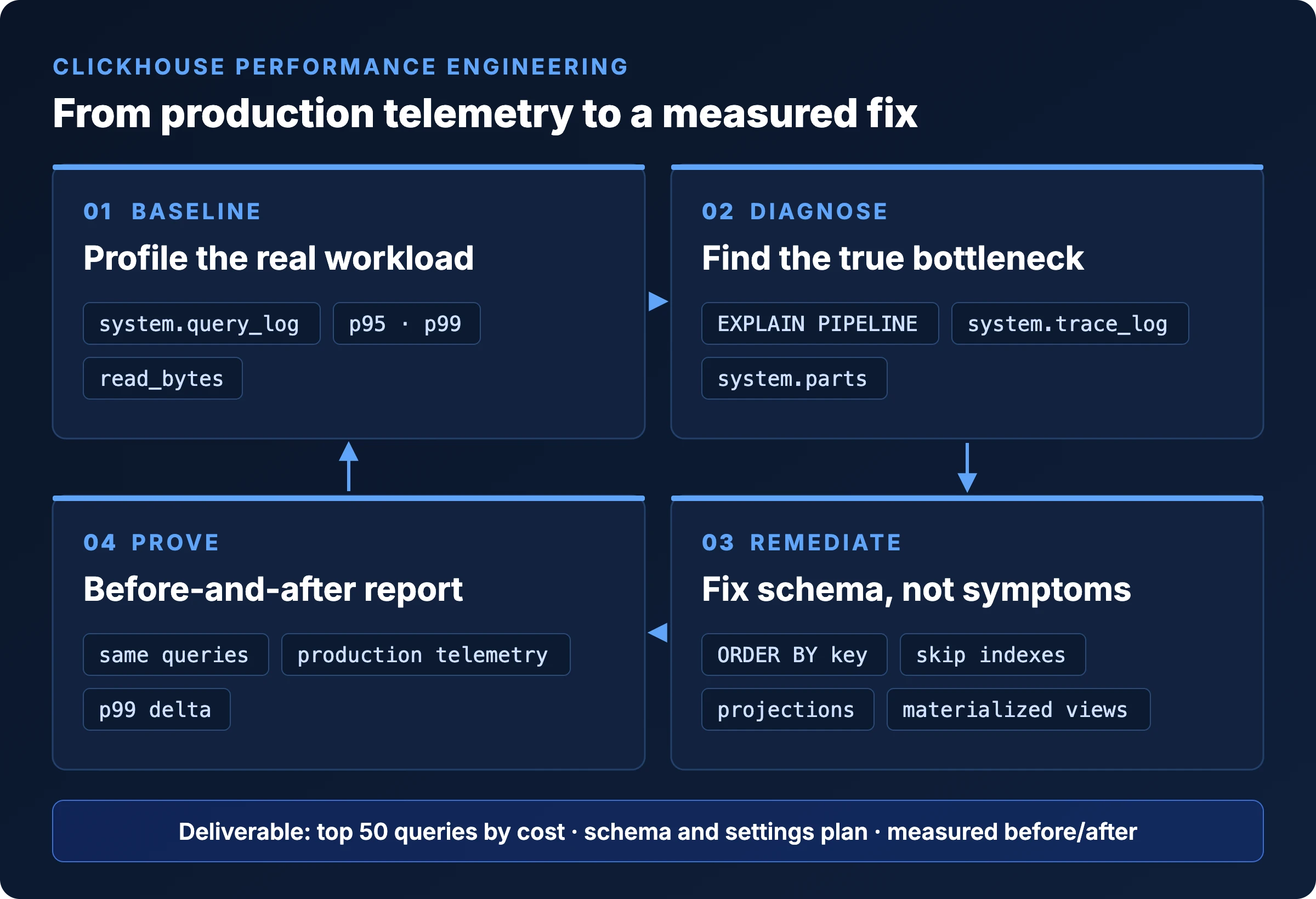
Diagnostic engagements that find and eliminate the ClickHouse bottlenecks an APM dashboard cannot see — using EXPLAIN PIPELINE, system.query_log, system.trace_log, MergeTree part-level analysis, mutation diagnostics, vectorized-execution profiling, and OS-level traces on the running workload. The deliverable is a workload baseline, the top fifty queries by cost, an indexing and schema remediation plan, a MergeTree variable and cache settings tune-up, a materialized-view design where appropriate, and a measured before-and-after report against production telemetry.
The ChistaDATA performance team has reduced p99 ClickHouse query latency by an order of magnitude in production, recovered tens of terabytes of disk through compression and partition pruning, and tuned ingestion throughput from hundreds of thousands of rows per second to multi-million-row-per-second steady-state — documented in ClickHouse performance tuning and optimization case studies.
- Query plan optimization and EXPLAIN PIPELINE analysis
- MergeTree, skip-index, and projection tuning
- Materialized-view denormalization design
- OS, filesystem, and storage tuning
24×7 ClickHouse Enterprise Support and Managed Services
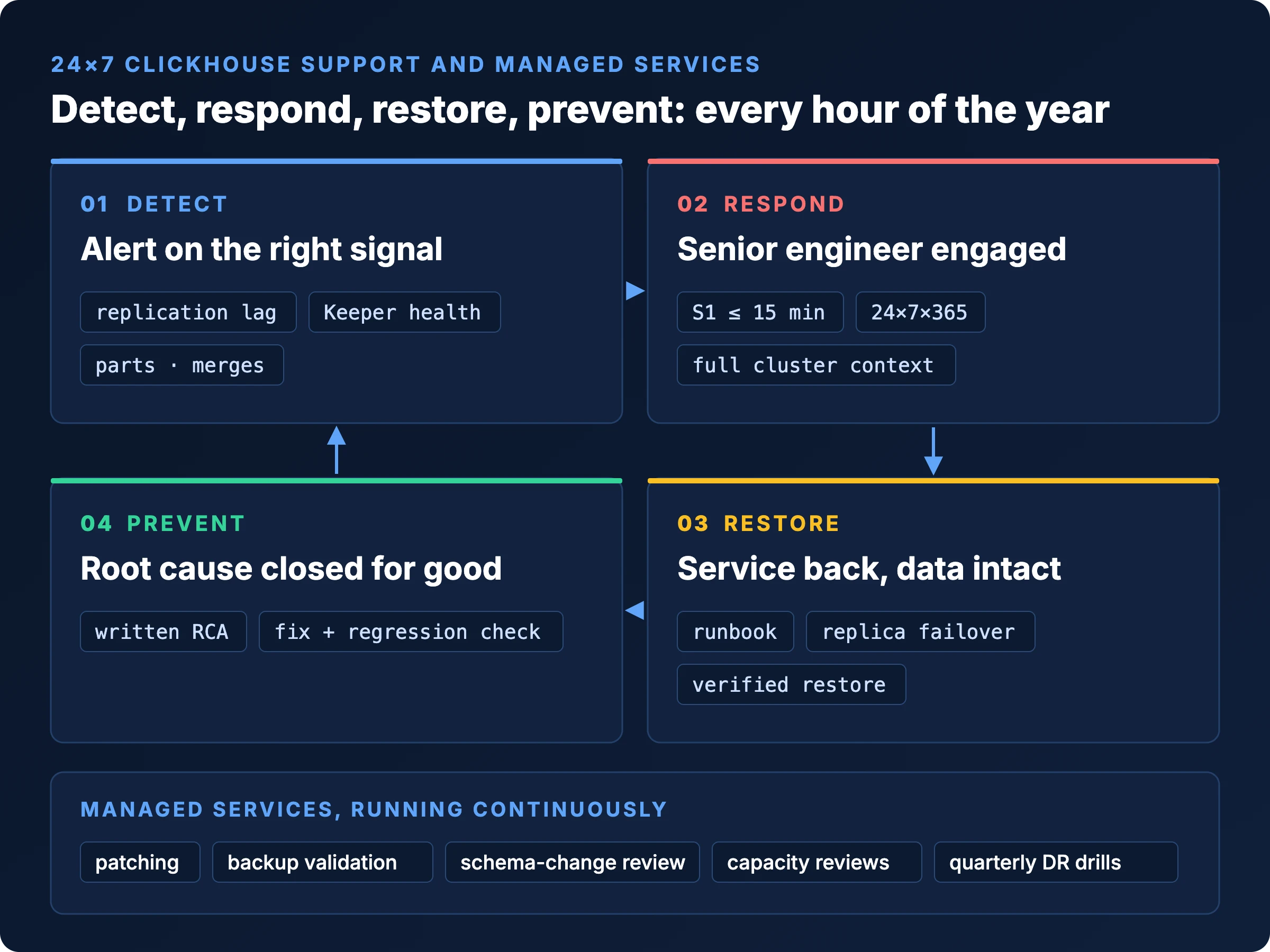
Operations as a service: continuous monitoring, paged incident response under strict SLA, patching, backup validation, schema-change review, capacity reviews, and quarterly architecture audits across self-managed ClickHouse clusters, ClickHouse Cloud, and Aiven.
The on-call ClickHouse engineer is a senior practitioner with full context on the customer cluster, not a triage queue handing tickets to a script. The Severity 1 response SLA is fifteen minutes, twenty-four hours a day, seven days a week, three hundred and sixty-five days a year. The fully managed ClickHouse offering takes operational ownership of the cluster so the customer engineering organization can focus entirely on the product roadmap. Customers commonly report a sixty-to-ninety percent reduction in total ClickHouse operating cost compared with building an in-house ClickHouse DBA function.
- 24×7×365 monitoring and on-call coverage
- Sev 1 fifteen-minute response SLA
- Patch, upgrade, and version management
- Backup, DR, security hardening, compliance reporting
ClickHouse Migration and Modernization: end-to-end migration engineering
End-to-end ClickHouse migration programs from Amazon Redshift, Snowflake, Google BigQuery, Apache Druid, Apache Pinot, Vertica, Teradata, Hadoop and Hive, Elasticsearch, and traditional MySQL, MariaDB, and PostgreSQL OLAP estates to ClickHouse. The migration practice covers schema conversion, query rewriting, dimensional and wide-table modeling for the column-oriented MergeTree engine, change-data-capture-based ingestion through Kafka and Debezium, application cutover orchestration, and the post-cutover stabilization period. Migration plans are scoped against a documented business case with measurable cost-per-query and latency targets agreed before the engineering work begins. See enterprise analytics transformation and the real-time analytics playbooks.
- Redshift, Snowflake, BigQuery to ClickHouse
- Druid, Pinot, Vertica, Teradata to ClickHouse
- Hadoop/Hive and Elasticsearch consolidation
- Schema conversion and CDC ingestion design
ClickHouse Engineering Scope
Every ClickHouse subsystem ChistaDATA engineers, tunes, and operates
The engineering surface area covers the ClickHouse server, the ingestion plane, the analytics plane, and the surrounding ecosystem the cluster depends on in production.
Storage and Table Engines
Distributed and Replication
Ingestion and Pipelines
Storage Tiering and Cloud
Query Performance and Caches
Observability and Operations
The ChistaDATA Method
Four steps from ClickHouse assessment to steady-state operations
Every engagement — from a focused two-week ClickHouse performance audit to a multi-quarter migration program — runs against the same engineering method.
01
Assess
Workload characterization, ClickHouse performance baseline, capacity and reliability audit, schema and query-pattern review, and a written gap analysis against the business commitment. The output is the source of truth for every recommendation that follows.
02
Architect
Target ClickHouse topology, sharding and replication plan, ingestion pipeline design, materialized-view and projection strategy, HA and DR design, security model, and a written remediation plan with concrete server configurations and operational runbooks.
03
Engineer
Senior ChistaDATA ClickHouse engineers implement the plan alongside the in-house engineering team, with reproducible change control, version-controlled configuration, and measured before-and-after telemetry on every change. Hand-offs are documented and signed.
04
Operate
Fully documented operational handover, or a 24×7 ClickHouse Managed Services contract with paged-engineer SLA, monthly engineering reviews, and quarterly architecture audits. The cluster stays measured, observable, and audit-ready through every business growth phase.
Why ChistaDATA
What makes ChistaDATA the ClickHouse engineering partner enterprises choose
Specialist ClickHouse depth, principal-engineer ownership, transparent engagement models, and an unwavering commitment to 100% open-source ClickHouse.
Specialists, Not Generalists
Every ChistaDATA engineer is a career ClickHouse specialist. The bench has shipped production ClickHouse clusters across AdTech, observability, fintech, telecom, IoT, SaaS analytics, and Generative AI workloads — not a sampling of databases with ClickHouse on the side.
100% Open-Source ClickHouse
ChistaDATA is committed to 100% GPL open-source ClickHouse with zero vendor lock-in. Customers retain full ownership of the binary, the configuration, and the data — deployable on any cloud, any region, any Kubernetes distribution, on-premises hardware, or ClickHouse Cloud.
24×7×365 Global Operations
Follow-the-sun ClickHouse engineering across eleven offices and a globally distributed Severity 1 response bench. The on-call engineer is a senior ClickHouse practitioner with full context on the cluster, not a level-one triage operator handing tickets to a script.
Boutique Discipline, Enterprise Scale
Engagement quality stays the same whether the customer is a Series A startup with a single ClickHouse node or a Fortune 500 with a multi-region fleet. The same senior engineers, the same written deliverables, the same engineering standard.
Transparent Pricing
Published ClickHouse consulting rates for on-site and remote engagements, subscription-based managed services plans sized from four hours per month upward, and enterprise support contracts with a single annual price covering unlimited ClickHouse instances. No surprise add-ons, no per-server licensing tax.
Audit-Ready Compliance
ChistaDATA delivers under GDPR, HIPAA, SOX, PCI DSS, and SOC 2 control environments. Encryption at rest and in transit, RBAC, query-level audit logging, change management, and access reviews are part of every architecture and every handover, with audit-ready documentation produced as a standard deliverable.
Industries We Serve
Built for industries where real-time analytics is a competitive advantage
ChistaDATA engineers operate ClickHouse for organizations where a sub-second query is the difference between winning a bid, catching a fraud, or shipping a feature. Every industry below is a domain the engineering bench has shipped to production.
AdTech, MarTech, and Programmatic
Real-time bidding analytics, attribution, audience segmentation, and frequency capping run on ClickHouse clusters ingesting trillions of events a day. ChistaDATA engineers the MergeTree topology, the materialized-view denormalization, and the query plan that holds p99 latency below one hundred milliseconds at programmatic auction scale.
Observability, SIEM, and Log Analytics
Tens of millions of metrics, logs, and traces per second flow through ChistaDATA-engineered ClickHouse clusters powering observability and SIEM platforms. The team designs the ingestion pipeline through Vector, Fluent Bit, OpenTelemetry, and Kafka, and tunes the analytical query plane that powers SOC dashboards and threat-hunting queries.
Financial Services and Fintech
Fraud detection, market data analytics, transaction risk scoring, and regulatory reporting demand audit-grade ClickHouse engineering under GDPR, PCI DSS, MiFID II, and SOC 2. ChistaDATA engineers ClickHouse clusters for capital markets operators and digital banks where a corrupted aggregate has financial consequences.
Hyperscale SaaS Analytics
Multi-tenant SaaS analytics, in-product dashboards, and customer-facing reporting at millions of MAU live or die on ClickHouse query latency. ChistaDATA designs the sharding key, the materialized-view layer, and the row policy framework that keeps tenant queries fast, isolated, and cost-controlled.
Telecommunications and IoT
Call detail record analytics, subscriber-data analytics, network probe ingestion, and IoT time-series workloads land on ClickHouse engineered by ChistaDATA. High-write-throughput ingestion, partition lifecycle management, multi-region replication, and zero-downtime upgrades are designed in from day one.
Generative AI and Machine Learning
Real-time feature stores, embedding analytics, model-quality telemetry, and the analytical layer behind Generative AI on ClickHouse are operated by the ChistaDATA engineering team. ClickHouse is engineered as the analytical companion to vector search and the lakehouse, not a replacement for them.
Engagement Models
Three engagement models, sized to the business outcome
Every engagement starts with a documented scope, a measurable outcome, and a transparent rate. Customers can flex up or down each quarter as the business roadmap evolves.
Project Engineering
Fixed-scope engagements that produce a written deliverable: a ClickHouse performance audit, an architecture review, a migration runbook, a HA and DR design, or a security and compliance hardening plan. Typical duration is two to twelve weeks. Output is engineering-ready and operational from the day of handover, with every recommendation tied to a measured baseline. The pre-engagement questionnaire kicks off the scoping conversation.
ClickHouse Consulting Retainer
A continuous engagement that gives the customer engineering team on-demand access to ChistaDATA principal ClickHouse engineers for ongoing tuning, query optimization, schema reviews, capacity planning, and architectural guidance. Remote ClickHouse consulting is published at US$450 per hour and on-site engagements at US$600 per hour. Engagements begin at a forty-hour minimum and flex against business demand with no rollover trap or unused-hours penalty.
ClickHouse Managed Services
Fully managed ClickHouse operations under a contracted SLA: 24×7×365 monitoring, paged-engineer incident response with a fifteen-minute Severity 1 SLA, patching and version management, backup validation, schema-change review, capacity reviews, and quarterly architecture audits. Subscription plans are sized from four hours per month to forty hours per month with quarterly, six-monthly, and annual terms. Enterprise support for unlimited ClickHouse instances is offered at US$75,000 per year.
Outcomes
What ChistaDATA ClickHouse engagements consistently deliver
Every engagement is measured. The outcomes below are what ChistaDATA customers consistently report across the engineering portfolio.
10× Query Latency Reduction
ClickHouse performance audits routinely cut p99 query latency by an order of magnitude through skip-index design, projection engineering, materialized-view denormalization, and MergeTree variable tuning — verified against production telemetry, not synthetic benchmarks.
100M+ Rows-per-Second Ingestion
Ingestion pipelines engineered by ChistaDATA sustain hundreds of thousands to multi-million rows-per-second steady-state across Kafka, Debezium, Kinesis, RabbitMQ, and HTTP ingestion paths — with predictable backpressure and zero data loss.
15 min Severity 1 Response
Enterprise support customers receive a fifteen-minute Severity 1 response SLA, twenty-four hours a day, three hundred and sixty-five days a year. The on-call engineer is a senior ClickHouse practitioner with full cluster context.
60-90% Operating Cost Reduction
ChistaDATA Managed Services customers consistently report sixty to ninety percent reduction in total ClickHouse operating cost compared with building an in-house ClickHouse DBA function and tooling stack from scratch.
Audit-Ready Compliance
Every cluster ships with audit-ready documentation under GDPR, HIPAA, SOX, PCI DSS, and SOC 2 controls: encryption posture, RBAC matrix, query audit log, change-management evidence, and access review cadence.
Zero Vendor Lock-In
Customers retain full ownership of the ClickHouse binary, the configuration, and the data. Every recommendation is 100% open-source ClickHouse — portable across ClickHouse Cloud, Aiven, Altinity.Cloud, AWS, Azure, GCP, Kubernetes, and on-premises hardware.
Behind every one of those headline numbers is a written deliverable: an architecture document, a performance audit report, a runbook, an incident-response timeline, a quarterly executive review, or a compliance evidence pack. The ChistaDATA engineering operating system is built on the principle that performance, scalability, availability, security, and cost are not opinions — they are measurements. Every customer engagement closes the loop with a written quarterly business review that surfaces the cluster’s SLO posture, the cost-per-query trend, the data-volume trajectory, the upcoming engineering roadmap, and the next twelve months of capacity planning. That is the ChistaDATA standard, and it travels with every ClickHouse cluster the engineering team is responsible for.
From the Founder
A note from Shiv Iyer
ChistaDATA was founded on a single conviction: the real-time analytics tier is the most consequential, least forgiving layer of every modern data-driven business, and ClickHouse is the engine that gets it right — if the engineering is right. After two decades operating planet-scale data infrastructure across telecommunications, capital markets, healthcare, and hyperscale consumer platforms, the pattern was unmistakable: ClickHouse delivered the cost-performance ratio and the column-oriented architecture every analytical workload eventually demands, and the businesses that engineered ClickHouse seriously won the operational outcome.
ChistaDATA exists to be the ClickHouse engineering partner enterprises can pick up the phone and call when sub-second analytics has to ship and stay up. The bench is built from career ClickHouse engineers, the operating model is built on written deliverables and measurable outcomes, and the engineering standard is the same regardless of company size, contract value, or cluster footprint. The partnership with MinervaDB Inc. — the broader database engineering practice across PostgreSQL, MySQL, MongoDB, and the rest of the database landscape — means ChistaDATA customers reach a full-stack data engineering bench when the analytical tier touches the transactional layer.
“ClickHouse is not just another column store. ClickHouse is the engine that makes real-time analytics economically possible at petabyte scale — and engineering it correctly is the difference between a dashboard that ships and a dashboard that scales. ChistaDATA exists to deliver that engineering with the seriousness it deserves.”
Shiv Iyer
Founder and Chief Executive Officer, ChistaDATA Inc.
Frequently Asked Questions
ClickHouse engineering questions, answered by ChistaDATA
What does ChistaDATA do?
ChistaDATA Inc. is a specialist ClickHouse consulting and managed services firm headquartered in the San Francisco Bay Area with engineering offices distributed across eleven global locations. The company was founded by senior database engineers from the MinervaDB Inc. infrastructure operations practice to deliver enterprise-grade ClickHouse engineering as a dedicated specialty rather than a side practice inside a generalist consulting firm. The engineering team designs, builds, tunes, and operates production ClickHouse infrastructure for real-time analytics, observability, time-series, AdTech, fintech, SaaS, and Generative AI workloads — through ClickHouse consulting, 24×7 enterprise support, managed services, migration engineering, performance audits, and break-fix engineering.
How does ChistaDATA support ClickHouse 24×7?
The ChistaDATA Enterprise ClickHouse Support program operates 24×7×365 with a fifteen-minute Severity 1 response SLA. Every customer is assigned a Technical Account Manager, ten named customer contacts, and reach through phone, email, dedicated Slack channel, online ticketing, and Zoom-based bridge calls. Senior ClickHouse engineers are globally distributed across eleven offices to deliver follow-the-sun coverage.
What is the cost of ChistaDATA ClickHouse consulting and managed services?
On-site ClickHouse consulting is published at US$600 per hour and remote consulting at US$450 per hour, with a forty-hour engagement minimum. Managed Services subscription plans are sized from four hours per month to forty hours per month with quarterly, six-monthly, and annual terms. Enterprise ClickHouse Support covering unlimited ClickHouse instances is offered at US$75,000 per year.
How does ChistaDATA migrate analytics platforms to ClickHouse?
The ClickHouse migration practice runs end-to-end programs from Amazon Redshift, Snowflake, Google BigQuery, Apache Druid, Apache Pinot, Vertica, Teradata, Hadoop and Hive, and Elasticsearch to ClickHouse. The program covers schema conversion, query rewriting, MergeTree modeling, CDC-based ingestion through Kafka and Debezium, application cutover orchestration, and the post-cutover stabilization period. Every migration is scoped against a documented business case with measurable cost-per-query and latency targets.
Can ChistaDATA operate ClickHouse on ClickHouse Cloud, Aiven, and the major hyperscalers?
Yes. ChistaDATA engineers are vendor-neutral across ClickHouse deployment topologies — self-managed ClickHouse on AWS, Azure, GCP, OCI, and Kubernetes; ClickHouse Cloud; Aiven for ClickHouse; and Altinity.Cloud. The engineering standard is the same regardless of where the cluster runs, and customers retain full ownership of the binary, the configuration, and the data.
Which compliance frameworks does ChistaDATA operate under?
ChistaDATA delivers under GDPR, HIPAA, SOX, PCI DSS, and SOC 2 control environments. Encryption at rest and in transit, RBAC with row- and column-level security, query-level audit logging, change management, named-collection secret hygiene, and access reviews are part of every architecture and every handover. Audit-ready documentation is produced as a standard deliverable.
How quickly can ChistaDATA engage on a ClickHouse incident or performance problem?
Enterprise Support customers receive a fifteen-minute Severity 1 response SLA, twenty-four hours a day. For new engagements, a ClickHouse performance audit or an emergency break-fix engagement typically begins within one to two business days once contracting completes. The pre-engagement questionnaire initiates the conversation.
How does ChistaDATA compare with Altinity, ClickHouse Cloud, and in-house hiring?
ChistaDATA is engine-focused on ClickHouse and operationally neutral across every deployment topology — self-managed, ClickHouse Cloud, Aiven, and Kubernetes. The engineering bench has shipped production ClickHouse to AdTech, observability, fintech, telecom, SaaS, and Generative AI workloads at petabyte scale, and the engagement model is built on principal-engineer ownership and written deliverables. Compared with hiring an in-house senior ClickHouse DBA, customers typically realize sixty to ninety percent cost reduction through the flexible engagement models and the shared-bench advantage.
Does ChistaDATA support break-fix and one-off ClickHouse emergencies?
Yes. The ChistaDATA Break-Fix engineering practice engages on emergency ClickHouse escalations — cluster outages, replication breaks, mutation storms, slow queries, MergeTree corruption, and security incidents. Initial engineering presence is typically available within a few business hours under existing-customer SLAs.
What does the ChistaDATA Data SRE practice cover?
The Data SRE practice applies Site Reliability Engineering principles to ClickHouse: error budgets and SLOs, deep observability with system.* telemetry and Prometheus exporters, blameless postmortems, runbook automation, and chaos testing. The deliverable is a ClickHouse cluster that operates at the maturity a Tier-1 internet platform demands.
Can ChistaDATA help with ClickHouse Cloud and DBaaS cost and performance optimization?
Yes. The DBaaS optimisation practice runs cost and performance optimization on ClickHouse Cloud, Aiven, and Altinity.Cloud deployments. Customers routinely reclaim twenty to forty percent of monthly ClickHouse spend through right-sizing, query-plan optimization, tiered storage, and ingestion path tuning.
What does the ChistaDATA Cloud product include?
The ChistaDATA Cloud offering provides a managed real-time analytics platform built on open-source ClickHouse and the ChistaDATA Server for ClickHouse control plane. Customers receive a production-ready ClickHouse cluster with ChistaDATA engineering ownership, transparent pricing, and zero vendor lock-in. Cloud account registration initiates the onboarding flow.
Does ChistaDATA work with Generative AI and machine-learning teams?
Yes. The Generative AI on ClickHouse and ClickHouse machine learning practices design the analytical tier behind real-time feature stores, embedding analytics, model-quality telemetry, and RAG-style retrieval workloads. ClickHouse is engineered as the analytical companion to vector search and the lakehouse, not a replacement for them.
Where can I find ChistaDATA technical content and training?
The ChistaDATA Knowledge Base and ChistaDATA University publish in-depth ClickHouse engineering content covering performance, scalability, MergeTree internals, query optimization, observability, and operational best practices. Engineering teams use the published material as the canonical reference for sort-key design on MergeTree, query-plan reasoning, distributed-table sharding strategy, ClickHouse Keeper deployment topology, and the operational runbooks that keep production clusters healthy at scale.
How does ChistaDATA tune ClickHouse performance and what kind of latency improvements are realistic?
The ClickHouse performance tuning and optimization practice begins with a structured ClickHouse performance audit that maps every workload to the underlying MergeTree configuration, sort-key topology, partition strategy, projection layout, materialized-view pipeline, distributed-table fan-out, merge concurrency, mark cache behaviour, and primary-key cardinality. From that audit, the engineering team publishes a written performance audit recommendation with measurable targets. Customers routinely achieve five to ten times reduction in query latency on dashboards, ten to one hundred times speedup on cold scans through proper projection design, and sustained ingestion of one hundred million rows per second per cluster after tuning batch-size, async-insert, and merge tree settings.
What is the difference between ChistaDATA Consulting, Managed Services, and Enterprise Support?
ChistaDATA Consulting is a project-scoped engagement — an audit, an architecture, a migration, or a performance program — priced at the published hourly rate. ChistaDATA Managed Services is a subscription engagement where a tiered engineering bench of four to forty hours per month operates the cluster proactively against documented SLOs. ChistaDATA Enterprise ClickHouse Support is a 24×7×365 reactive incident-response plan covering unlimited ClickHouse instances at US$75,000 per year, designed for organizations whose internal DBA team owns the cluster but needs a globally distributed escalation bench. Many customers combine all three: managed services for steady-state operations, enterprise support for the safety net, and consulting for one-off architecture and migration programs.
How does ChistaDATA design ClickHouse for high availability and disaster recovery?
High availability is engineered through ReplicatedMergeTree on top of ClickHouse Keeper or ZooKeeper quorum, multi-replica shard topology across availability zones, write-path and read-path failover, replica-staleness monitoring, and partition-level integrity checks. Disaster recovery is engineered through tiered storage to object stores, cross-region replication, point-in-time recovery using BACKUP and RESTORE against S3-compatible targets, runbook-driven rebuild procedures, and quarterly restore-validation exercises. The engineering team publishes a Recovery Time Objective and Recovery Point Objective against every cluster as a written deliverable.
What kind of ClickHouse observability does ChistaDATA implement?
The ChistaDATA observability standard is built on the ClickHouse system.* tables — system.query_log, system.query_thread_log, system.part_log, system.merges, system.mutations, system.replication_queue, system.errors, system.asynchronous_metrics — streamed into Prometheus, Grafana, or the customer’s existing observability platform through Prometheus exporters. Dashboards cover query latency percentiles, ingestion throughput, merge backlog, mutation queue depth, replica lag, mark-cache hit rate, and per-table compression ratios. Alerting is wired to the on-call rotation against the same SLO definitions used in the Data SRE practice, so the cluster speaks before the dashboards do.
Does ChistaDATA help architect ClickHouse for AdTech, observability, fintech, and SaaS workloads?
Yes — the engineering bench has shipped reference ClickHouse architectures into each of these workload categories. AdTech engagements are designed for trillions of events per day, sub-second bidder-side reporting, and second-level campaign attribution. Observability and SIEM engagements ingest tens of millions of metrics, logs, and traces per second with cardinality and retention engineered for unit-economics. Fintech engagements operate under PCI DSS, SOC 2, and SOX controls with sub-second fraud-detection windows. SaaS analytics tiers are engineered for multi-tenant isolation, row-level security, per-tenant cost attribution, and embedded customer-facing dashboards. The ChistaDATA transforming enterprise analytics and real-time analytics practices document the patterns used across these workloads.
Let’s engineer the ClickHouse layer the business deserves
Whether the next milestone is a ClickHouse migration off Redshift, Snowflake, BigQuery, Druid, or Pinot, a performance program against a strict latency SLA, or a fully managed ClickHouse contract that frees the engineering team to focus on the product — a fifteen-minute conversation with a ChistaDATA principal engineer is enough to know whether ChistaDATA is the right partner. Reach the engineering team through contact-chistadata-inc or the support contact form.
ChistaDATA Inc. · San Francisco Bay Area · 11 global offices · 24×7×365 ClickHouse engineering operations