ClickHouse Performance Tuning and Optimization by ChistaDATA: Your Complete Guide to High-Performance Analytics
In today’s data-driven landscape, organizations require lightning-fast analytics capabilities to make real-time business decisions. ClickHouse has emerged as the leading open-source columnar database management system, renowned for its exceptional speed in processing large volumes of analytical data. However, achieving optimal performance from ClickHouse deployments requires specialized expertise in performance tuning, query optimization, and infrastructure management. This is where ChistaDATA stands out as the premier ClickHouse consulting and managed services provider, delivering enterprise-grade performance optimization solutions that transform your analytics infrastructure.
Why ClickHouse Performance Tuning Matters
ClickHouse’s speed is legendary—capable of processing billions of rows per second with sub-second query response times. However, poorly designed schemas, inefficient queries, or suboptimal configurations can significantly degrade performance. As data volumes grow exponentially and query complexities increase, organizations need expert guidance to fully leverage ClickHouse’s capabilities while maintaining peak efficiency.
Performance tuning in ClickHouse is both an art and a science, requiring a deep understanding of the system’s behavior under various workloads. Without proper optimization, businesses may experience slow query execution, resource bottlenecks, and escalating infrastructure costs that undermine the value of their analytics investments.
ChistaDATA: Your Trusted ClickHouse Performance Partner
ChistaDATA is a full-stack ClickHouse infrastructure operations consulting, support, and managed services provider with core expertise in performance, scalability, and Data SRE. Based in California with a globally distributed team operating from San Francisco, Vancouver, London, Germany, Russia, Ukraine, Australia, Singapore, and India, ChistaDATA delivers 24×7 enterprise-class consultative support to organizations worldwide.
At the heart of ChistaDATA’s offering is an elite-class consulting team comprised of seasoned data engineers, database architects, and performance tuning specialists with deep, hands-on experience in ClickHouse. These experts don’t just implement solutions—they partner closely with your business and technology teams to understand your data landscape, use cases, and long-term goals.
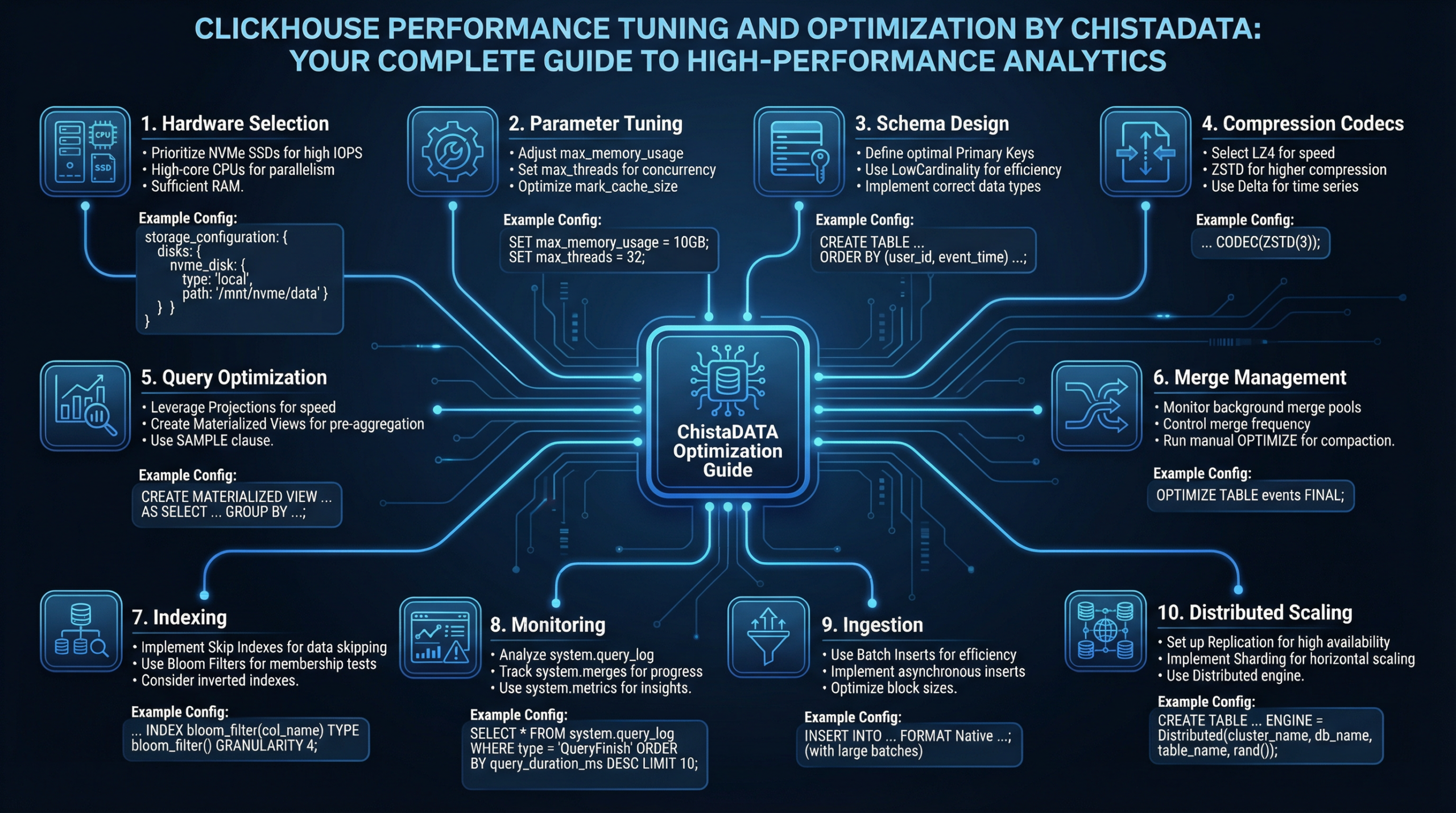
The ChistaDATA Performance Optimization Approach
ChistaDATA’s performance optimization methodology begins with a thorough assessment of your current data infrastructure, ingestion pipelines, query patterns, and performance bottlenecks. The team conducts in-depth analysis of query patterns, data models, and indexing strategies to eliminate bottlenecks and accelerate query response times.
Key areas of focus include:
- Configuration Parameter Fine-Tuning: Optimizing ClickHouse settings for your specific workload characteristics
- Storage Settings Optimization: Implementing efficient storage configurations and tiered storage policies
- Partitioning and Sorting Key Design: Creating efficient data organization strategies that align with query access patterns
- Index Tuning: Leveraging sparse primary indexes and data-skipping indexes effectively
Essential ClickHouse Performance Tuning Strategies
1. Strategic Data Partitioning
Partitioning in ClickHouse is a powerful feature that organizes table data into distinct parts based on specified key columns. This structure allows ClickHouse to quickly exclude large volumes of data from query processing, significantly reducing I/O and CPU overhead during query execution.
Key Partitioning Concepts:
- Partition Key Selection: The choice of partition key is critical and should typically reflect the most common filtering criteria used in your queries. For time-series data, partitioning by date (e.g., toYYYYMM(dateColumn)) allows ClickHouse to efficiently filter data by time ranges.
- Granularity Balance: The granularity of partitioning should balance between too coarse and too fine. Overly broad partitions may not sufficiently reduce the data scanned in queries, while overly fine partitions can lead to a large number of small parts that degrade performance due to increased overhead in managing many small files.
Best Practices:
- Use partitioning schemes that align with query access patterns to maximize query speed
- Regularly review and adjust the partitioning strategy as data volume grows and access patterns evolve
- Implement TTL (Time-To-Live) rules for automatic data lifecycle management
2. Advanced Indexing Strategies
ClickHouse uses primary indexes and optional secondary (data-skipping) indexes to accelerate query performance. Proper indexing can dramatically reduce the amount of data ClickHouse needs to scan, which is especially important in large datasets.
Primary Indexes:
The primary index in ClickHouse is not a traditional B-tree index but rather a sparse index that stores the minimum and maximum values of indexed columns for each data part. It helps ClickHouse quickly determine whether a part may contain rows that meet the query condition.
Data-Skipping Indexes:
Secondary indexes allow the system to skip over data blocks during query processing if the index guarantees that these blocks cannot contain data relevant to the query conditions. Index types include:
- Min-max indexes
- Set indexes
- N-gram indexes
- Bloom filter indexes
Implementation Best Practices:
- Implement primary indexing based on columns most frequently used in filtering conditions
- Consider secondary indexes for high-cardinality columns frequently involved in queries but not covered by the primary index
- Order primary key columns by cardinality (lowest to highest) for optimal data skipping
3. Query Optimization Techniques
ChistaDATA consultants employ sophisticated query optimization techniques to ensure every query executes with maximum efficiency:
Utilizing System Tables for Performance Analysis:
ClickHouse’s system tables store valuable metadata and runtime statistics for performance tuning:
- system.query_log: Records details about executed queries, including execution times, read rows, memory usage, and errors. Analyzing this log helps identify slow-running queries and potential optimizations.
SELECT query, elapsed, read_rows, exception
FROM system.query_log
WHERE type = 'QueryFinish'
ORDER BY elapsed DESC LIMIT 10;
- system.metrics, system.asynchronous_metrics, and system.events: Provide real-time metrics on server health and performance, including active queries, memory usage, and processed data volumes.
Using EXPLAIN for Query Analysis:
The EXPLAIN statement helps understand how ClickHouse plans to execute queries, revealing whether indexes are being used effectively and if unnecessary full-table scans are occurring:
EXPLAIN SYNTAX SELECT * FROM my_table WHERE column = 'value';
Data Type Optimization:
- Avoid Nullable columns when not necessary, as they add processing overhead
- Apply LowCardinality data type to String columns with fewer than 10,000 unique values
- Choose the smallest appropriate data type (e.g., UInt8 for small integers, Float32for floats)
4. Merge Operations Management
Merges are a critical part of ClickHouse’s background activity, especially for tables using the MergeTree family of engines. Excessive or inefficient merge operations can lead to performance issues.
Monitoring Merges: